Offshore species of fish in Panama
Black Marlin
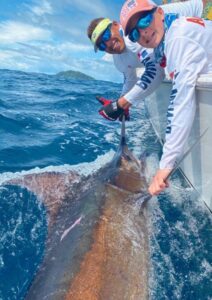
One of the best countries in Central America for Black marlin fishing is hands down Panama. Black marlin is one of the most sought-after game fish due to their size, which can reach up to 15.3 feet (4.65 meters) and weigh up to 1,650 pounds. The “Pearl of the Ocean” is a strong fighter that lives in the Pacific. It is the 9th fastest animal in the world and the fastest fish, reaching speeds of 80 mph (129 km/h). Unlike the blue marlin, the black marlin does come closer to the shore near reefs and landmasses. In Panama, you can find them in Hannibal Bank and near Coiba.
To catch them, we use live bait such as mackerel, bonito or small yellowfin tuna. When you catch one it will turn black, but when it is alive it is dark blue and white making it easy to confuse with the blue marlin.
Best time to catch a black marlin in Panama: dry season (December through March), but it is generally tied to seasonal bait movements and offshore fishing conditions around deep drop-offs and seamounts.
Blue Marlin
Unlike black marlin, the fight with a blue marlin begins the moment it takes the lure. Males typically stay under 400 pounds, while females grow much larger—sometimes reaching nearly 2,000 pounds—making them the true trophy-class fish.
Blue Marlin spend most of their lives in the open ocean and rarely come close to shore. Visually, they are similar to black marlin but retain a more distinct blue coloration even after capture, often showing bold vertical stripes when excited or stressed. Another key difference is in their fins: blue marlin have pectoral fins that fold easily against their body, while black marlin fins remain more rigid and upright.
Best time to catch a blue marlin in Panama: December through April is the season to catch blue marlins in Panama, which you can find around Hannibal Bank and Isla Montuosa.
Yellowfin Tuna
There are many species of tuna worldwide, but in Panama, you will find the yellowfin tuna, also referred to as “ahi tuna”. This tuna lives in tropical waters and is a fast and strong fish due to its shape. It is easy to distinguish this colorful fish since it has a silver belly with metallic blue on its top and yellow fins, tail, and stripes. Yellowfin Tuna can range in weight from 10 to 400 pounds. If you want to catch bigger fish, it’s best to use live bait and wait till they tire out to reel them in. They travel in schools of their own kind or with other species including dolphins, whales, and whale sharks.
The best time to catch yellowfin tuna in Panama: from March through July, although fishermen can find them throughout the year. To find them, we usually head offshore to Isla Montuosa, Hannibal Bank or Isla Jicaron.
Dorado or Mahi-Mahi
Common Dolphinfish—often called dorado, dolphinfish, or mahi-mahi (a Hawaiian term meaning “very strong”)—are one of the most colorful and exciting pelagic species found in Central America. Known for their explosive speed and acrobatic fights, dorado frequently leap out of the water during the battle, flashing their vivid greens, blues, and golds—making them one of the most visually spectacular game fish in the ocean.
Dorado are highly versatile and can be found both inshore and offshore, often following floating debris, weed lines, and current edges. They usually travel in schools, although larger solitary males—known as “bull” dorado—are commonly found on their own or in smaller groups.
Best time to fish dorado in Panama: Peak fishing typically occurs from October through February, with November and December often producing some of the best action, including fish in the 40–60 pound range. The least productive period is generally May through August, when sightings and catches tend to drop.
Sailfish
Indo-Pacific Sailfish are found throughout the warm waters of the Pacific and Indian Oceans. This species typically grows larger than its Atlantic counterpart, with fish over 100 pounds commonly encountered in many regions. Renowned for their speed and dramatic aerial displays, sailfish are a favorite among saltwater anglers. Despite their power and agility, they tend to tire relatively quickly once hooked, making them a classic light-tackle sport fish.
Common fishing techniques include trolling with strip baits, lures, feathers, or spoons, as well as live-bait and kite fishing methods. The most consistent action is found when sailfish are actively feeding near the surface, where they can be seen chasing bait schools and striking with explosive bursts of speed.
The best time for sailfish in Panama: from December through April, with the highest concentrations and most consistent action typically occurring between February and April, once the winds are calmer.
Wahoo
Mornings are the best time to catch them, so it is best to get an early start. This prized game fish is fast and long. They can swim up to 60 mph and grow up to 8.2 feet (2.5 meters) in length. It is silver in color with blue in its back and stripes which go down its body. People confuse them with barracudas since they both have razor-sharp teeth.
The best time to catch wahoo in Panama: from September to December.